
Direct Summary (Quick Answer)
A window screen is an insert designed to let fresh air in while keeping insects and debris out. It consists of a four-sided aluminum or vinyl frame, tensioned mesh fabric, a flexible spline cord that anchors the mesh in the frame's perimeter channel, and corner connectors. Window screens vary by coverage (half screens covering the movable sash or full screens covering the entire window opening), window operation (sliding, casement wicket, hinged, or fixed exterior), and frame profile geometry (commonly nominal 5/16 inch, 3/8 inch, or 7/16 inch depths in either box or lipped/flanged styles). Because window frame track channels vary by manufacturer, proper fitment requires measuring the existing opening, retention hardware, and applicable manufacturer workflow rather than assuming generic dimensions.
Understanding Window Screen Anatomy
At first glance, a window screen looks like a simple rectangular frame holding a piece of mesh. In practice, it is a balanced mechanical assembly where frame rigidity, mesh tension, and mounting hardware work together.
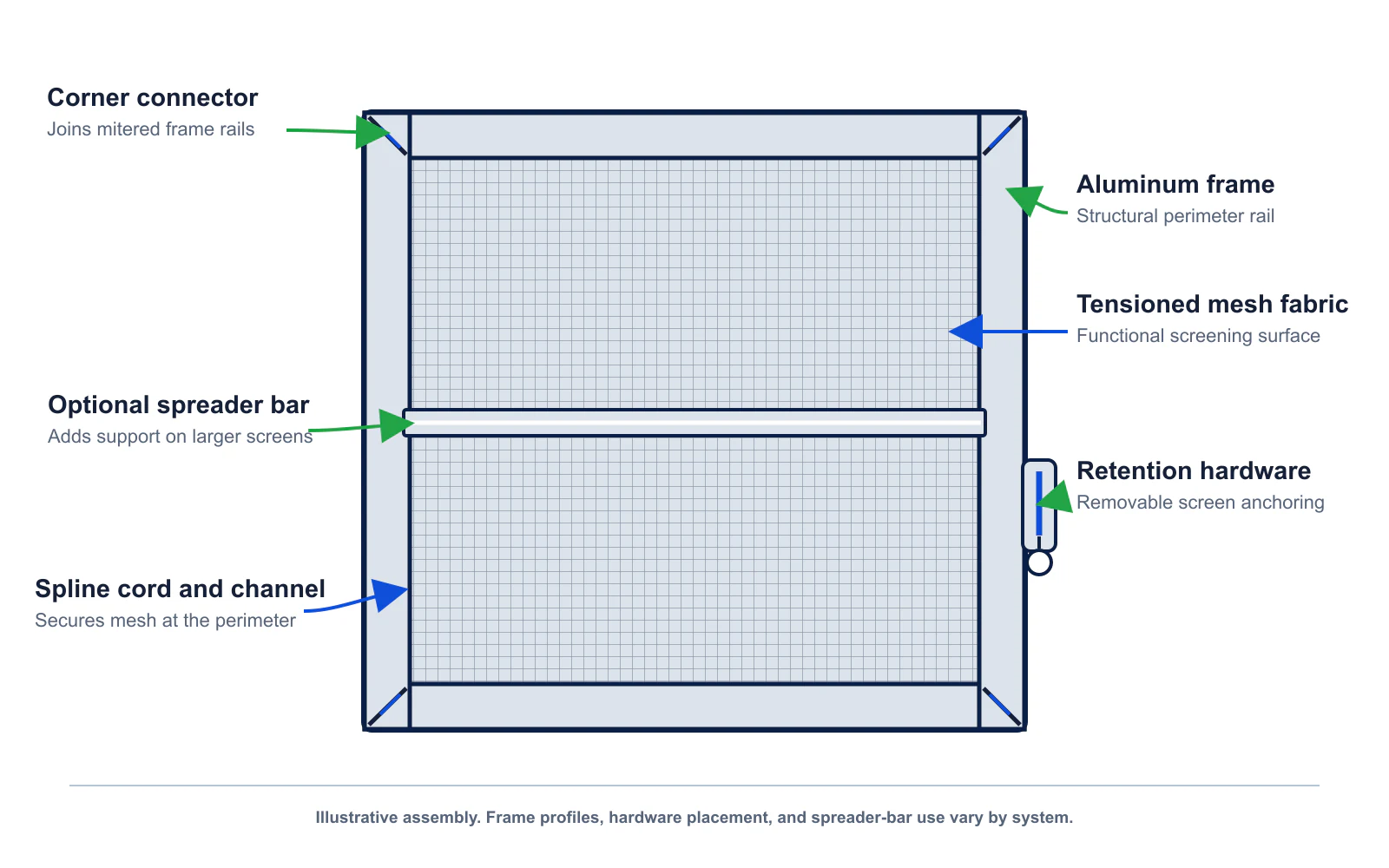
- The Frame Profile: Aluminum or vinyl channels cut to length to form the rectangular border. The frame profile includes an open channel (the spline groove) where the mesh is seated.
- The Screen Mesh: The woven material that provides insect filtration, solar shading, or pet resistance while allowing natural light and airflow.
- The Spline: A flexible vinyl, foam, or rubber cord pressed into the spline groove with a rolling tool to lock the mesh under tension.
- Corner Connectors (Keys): Hardware that joins the four frame sections together at 90-degree angles. These can be internal metal or plastic keys used with 45-degree miter-cut frames, or external plastic slip-on corners used with square-cut frames.
Roll-Formed vs. Extruded Aluminum Profiles
- Roll-Formed Aluminum: Made by feeding flat aluminum coil through forming rollers to create a hollow profile with a visible seam. C.R. Laurence residential screen frame profiles include nominal .020-inch wall thickness examples. Roll-formed framing is lightweight, economical, and common across residential replacement applications.Manufacturer Specification
- Extruded Aluminum: Made by pressing heated aluminum alloy through a shaped opening in a steel die, creating a solid, seamless wall. Extruded screen frames generally feature thicker walls - commonly ranging from .032 inch to .050 inch or higher depending on the specific extrusion profile - and can offer greater rigidity for oversized openings, commercial properties, or heavier mesh.Variable by System / Environment
Window Screen Types by Window Style
Window screens must match the operating mechanics of the specific window unit. Installing the wrong style can prevent the window from closing, leave gaps for insects, or make the screen impossible to remove for cleaning.
1. Half Window Screens
Half screens cover only the movable venting portion of a single-hung or horizontal sliding window.
- How They Work: They sit on the exterior of the window frame, positioned directly in front of the active sash.
- Advantages: Compact, lightweight, easy to remove and wash, and they leave the view through the fixed upper glass completely unobstructed.
- Considerations: They only provide insect protection when the designed movable sash is open. If a double-hung window uses the top sash, a half screen will not cover the upper opening.
2. Full Window Screens
Full screens span the entire height and width of the window opening.
- How They Work: They mount into an exterior channel or are held against the exterior window frame by retention clips, spring pins, or turn buttons.
- Advantages: On double-hung windows, full screens allow the upper and lower sashes to be open simultaneously, creating natural convective airflow.
- Fabrication Note: Larger full screens may use a horizontal spreader bar or crossbar to increase structural rigidity. Placement depends on frame system, wall gauge, mesh tension, and manufacturer instructions.Common Trade Practice
3. Horizontal Slider Window Screens
Designed for horizontal sliding windows, these screens sit in upper and lower tracks parallel to the movable glass panel. They often use top-mounted tension springs so the screen can be pushed upward into the top track, clearing the bottom track for removal.
4. Casement and Awning Window Screens (Interior Mounts)
Because casement and awning sashes typically project outward, their insect screens are commonly mounted on the interior side.
- Interior Mounting: Retention hardware such as knife latches, plunger pins, or wooden stop tracks secures the assembly to the room-side window frame.
- Wicket Access Doors: Older casement windows with manual push-out levers or rigid, non-folding hand cranks may use a screen with a small hinged wicket door built into the bottom rail.
Understanding Frame Profiles and Cross-Section Shapes
The frame profile determines whether a screen will slide smoothly into a window's retention channels or fail to seat properly.
Common Nominal Frame Depths
- 5/16 inch (Nominal 0.3125 inch) Profile: One of the most prevalent sizes available for residential vinyl and aluminum window screen replacement, commonly 3/4 inch wide by 5/16 inch deep.Variable by System / Environment
- 3/8 inch (Nominal 0.375 inch) Profile: Frequently used across wood-clad windows, commercial properties, and older residential aluminum systems, commonly 3/4 inch wide by 3/8 inch deep.Variable by System / Environment
- 7/16 inch (Nominal 0.4375 inch) Profile: A deeper profile commonly specified where window frames feature deeper accessory channels or for historical window restorations, commonly 3/4 inch wide by 7/16 inch deep.Variable by System / Environment
Box Frame vs. Lip (Flanged) Profiles
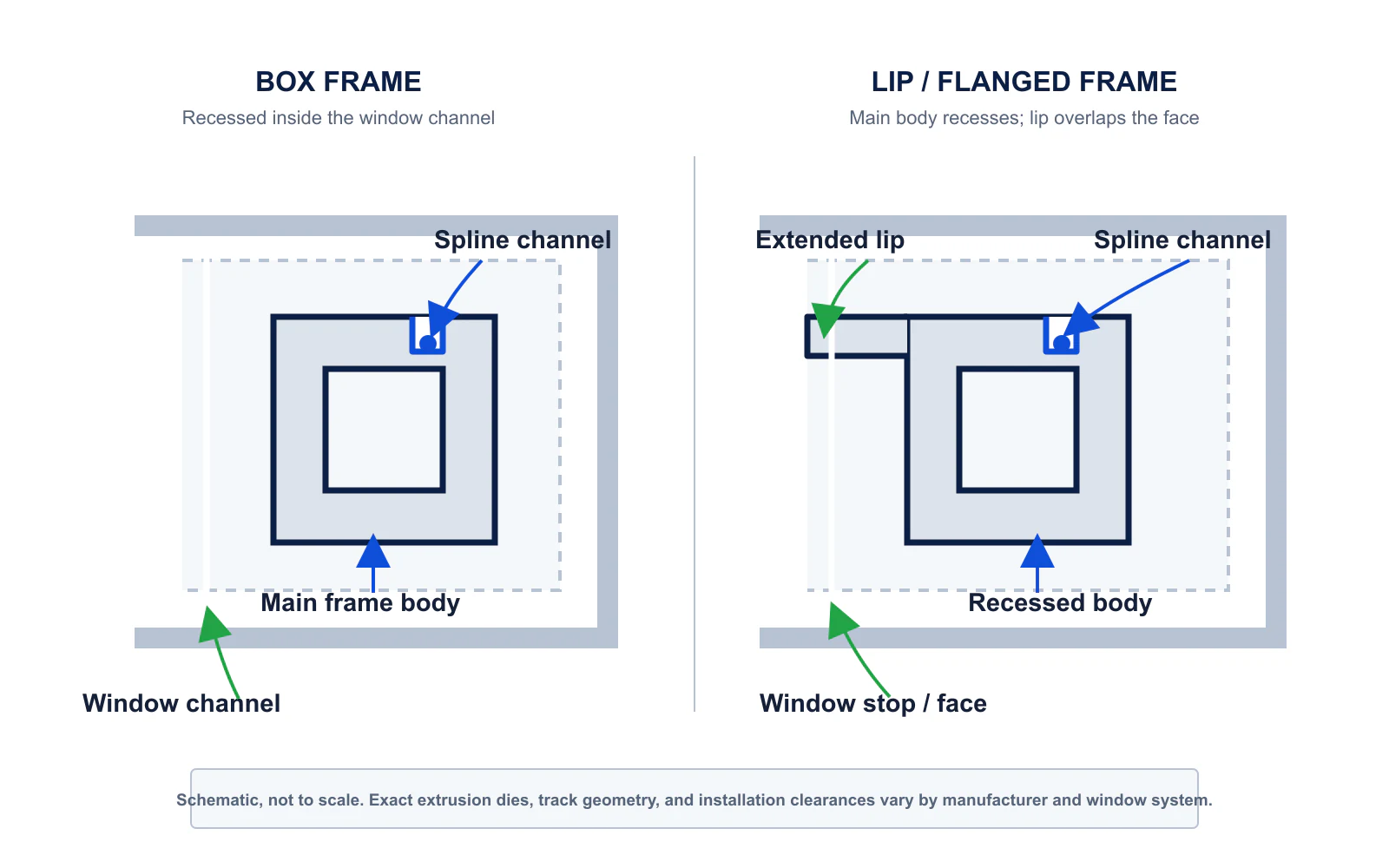
- Box Frame (Square Shape): A four-sided rectangular extrusion with flat sides. The entire frame sits recessed inside the window track channel and requires accurate measurements to enter the track without binding while leaving enough clearance for retention hardware.
- Lip Frame (Flanged Shape): Features an extended offset lip along one outer edge. The main body recesses into the window opening, while the lip overlaps the exterior face of the window frame or stop, acting as a visual baffle.
Frame Geometry and Application Guide
The table illustrates common component profiles and typical field applications. Because window frame designs vary by manufacturer, always measure existing window channels or old screen frames before ordering replacement materials.Variable by System / Environment
| Nominal profile depth | Construction type | Typical dimensions | Common field applications | Common retention hardware |
|---|---|---|---|---|
| 5/16 inch Box | Roll-Formed / Extruded | 3/4 W x 5/16 D (CRL WSF3516) | Vinyl single-hung and horizontal sliding windows | Top tension leaf springs, bottom pull tabs |
| 5/16 inch Lip | Roll-Formed | 3/4 W x 5/16 D + Lip (CRL WSFL8) | Aluminum sliders, storm window tracks | Friction fit, side plunger pins |
| 3/8 inch Box | Roll-Formed / Extruded | 3/4 W x 3/8 D (CRL WSF38) | Wood-clad windows, multi-family residential | Plunger pins, knife latches, turn buttons |
| 3/8 inch Lip | Roll-Formed | 3/4 W x 3/8 D + Lip | Retrofit wood casing applications | Turn buttons, side knife latches |
| 7/16 inch Box | Roll-Formed / Extruded | 3/4 W x 7/16 D (CRL WSF347M) | Deep-channel window frames, historic restorations | Top leaf springs, plunger pins |
Dimensions and part designations represent commercially available component profiles, including C.R. Laurence examples. Fitment varies by window brand.
How Window Screens Stay in Place (Retention Hardware)
Window screens rely on mechanical retention hardware to stay firmly seated in the window frame while remaining removable when needed.
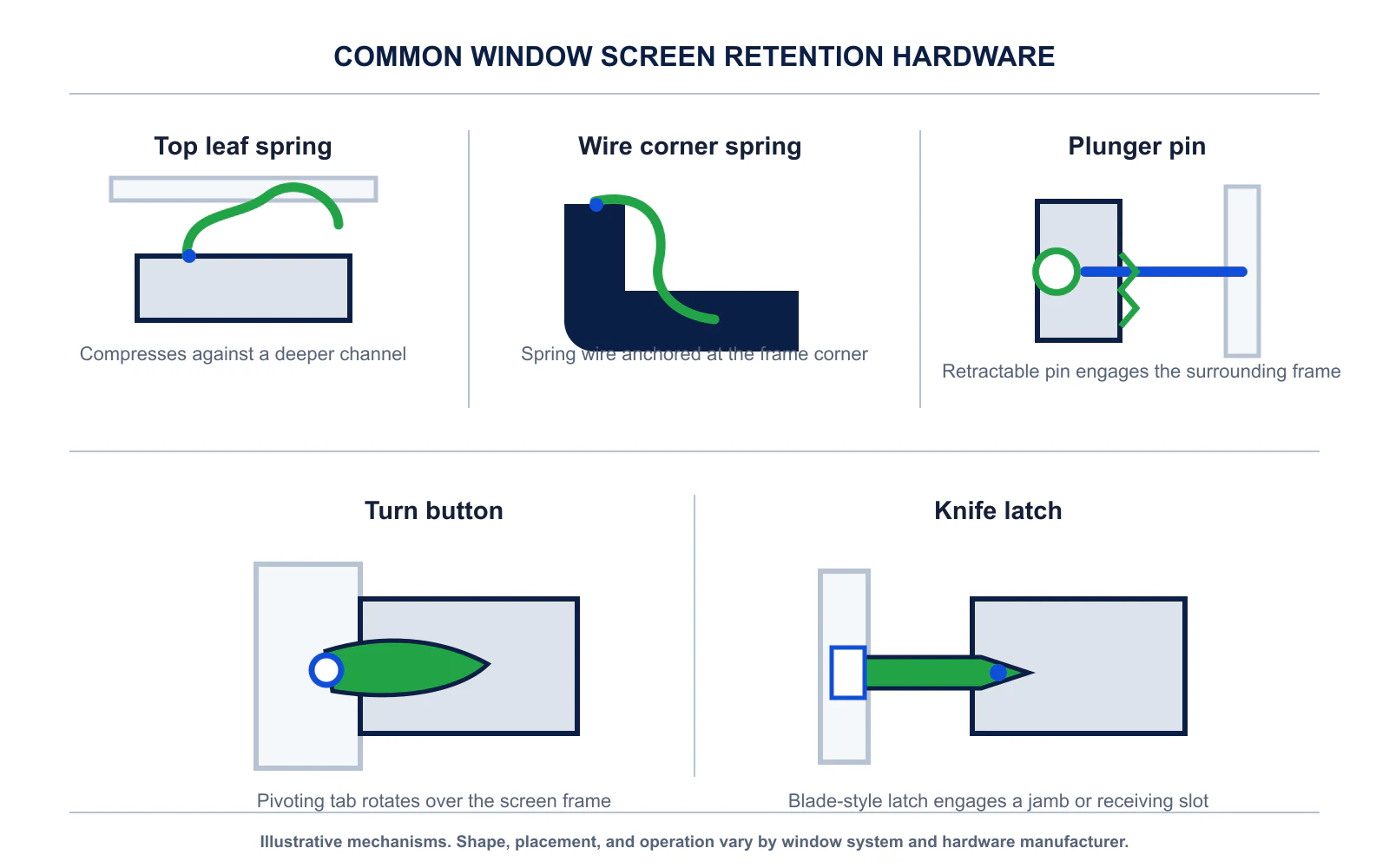
- Tension Leaf Springs and Wire Springs: Tempered spring-steel clips installed along the top or side rail. In a top-spring setup, pushing the screen into the deeper top channel compresses the springs, giving the bottom rail enough clearance to swing over the sill into the lower channel.
- Spring-Loaded Plunger Pins (Pull Pins): Small metal or plastic pins with internal coil springs, mounted through holes drilled into the screen frame. The spring pushes a pin tip into a corresponding hole in the window casing.
- Turn Buttons and Friction Clips: Surface-mounted plastic or metal levers that screw directly to the window jamb or casing, pivoting over the outer edge of the screen frame to hold it in place.
- Knife Latches: Flat metal sliding blades recessed into the side channel of the screen frame, standard on interior casement window screens.
Matching Mesh Materials with Spline Channels
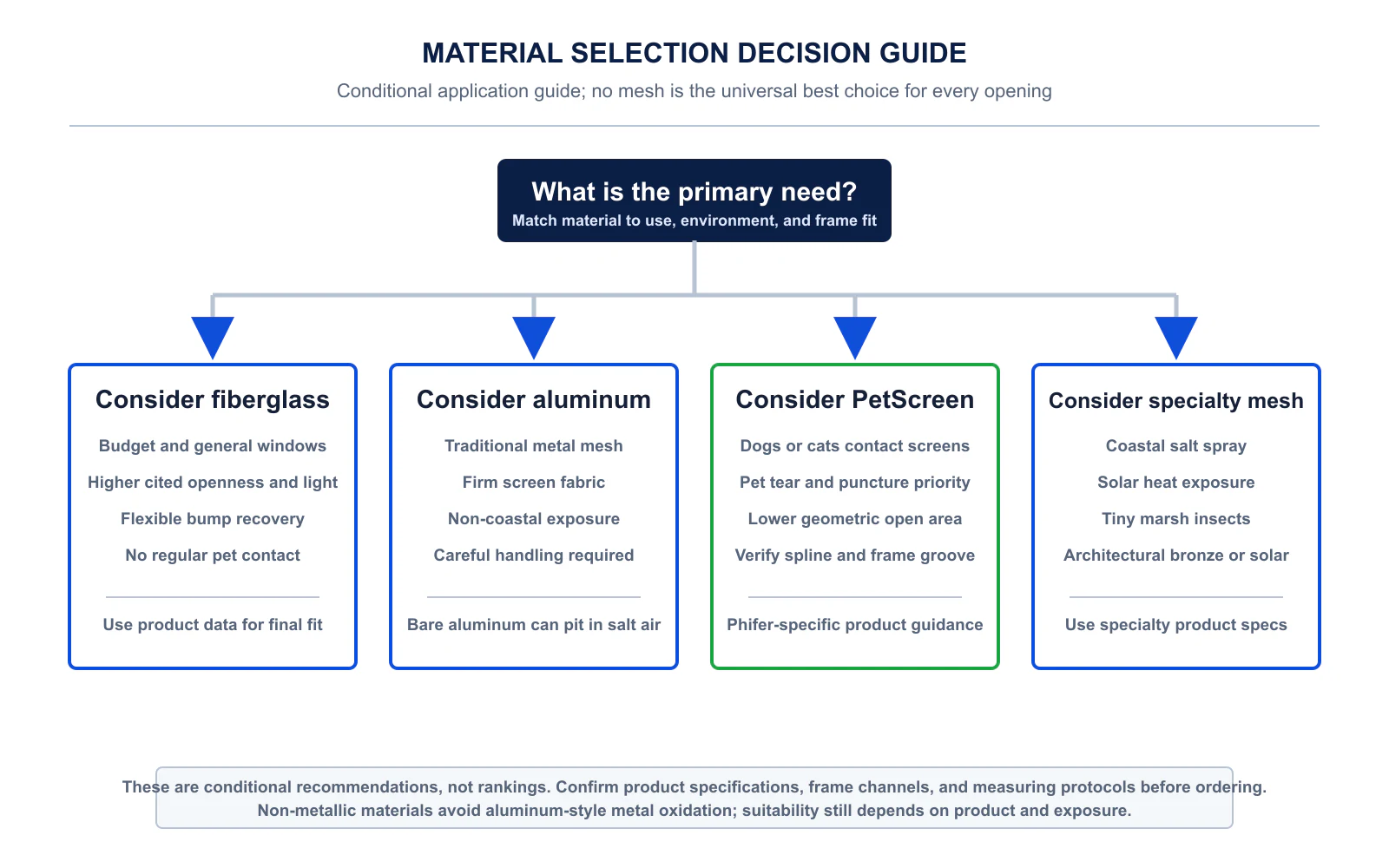
When rescreening or fabricating a window screen, the thickness of the mesh fabric affects what size spline is needed to secure it in the frame channel.
Standard Fiberglass Insect Mesh (ASTM D3656/D3656M-25)
Residential insect screening woven from vinyl-coated glass yarns is governed by ASTM D3656/D3656M-25, Standard Specification for Insect Screening and Louver Cloth Woven from Vinyl-Coated Glass Yarns.Consensus Industry Standard
- Class 1 (Standard 18 x 16 Mesh): Standard residential mesh with a nominal yarn diameter of 0.0115 inch (0.292 mm), designed for balanced insect protection, light transmission, and natural airflow.Consensus Industry Standard
- Class 2 (18 x 14 and 20 x 20 Mesh): Woven with a heavier nominal yarn diameter of 0.013 inch (0.330 mm) for enhanced strength or micro-insect protection.Consensus Industry Standard
- Spline Selection: Spline size must be selected from the frame groove width and mesh type. In representative residential examples, standard 18 x 16 fiberglass screening is commonly paired with .140-inch spline.Manufacturer Specification
Heavy-Duty Pet-Resistant Mesh (Phifer PetScreen Specifications)
Phifer technical data for PetScreen specifies a 17 x 10 mesh count, a 0.025-inch yarn diameter, a total fabric thickness of 0.036 inch, and approximately 36 percent openness.Manufacturer Specification
Thicker pet-resistant mesh occupies more physical volume in the frame groove. Phifer guidance recommends stepping down to a smaller spline size, with .125-inch spline shown in examples where standard fiberglass uses .140 inch.Manufacturer Specification
Solar Screen Mesh
Solar screening fabrics absorb and dissipate solar heat before it reaches window glass. Product ratings for Phifer SunScreen and Super Solar Screening+ document solar heat and glare blockage ranging from up to 70 percent to up to 90 percent, depending on weave density and fabric color.Manufacturer Specification
Troubleshooting Common Screen Fit Problems
| Observed problem | Likely mechanical cause | Practical field response |
|---|---|---|
| Frame bows inward at the center (hourglassing) | Mesh was pulled too tight laterally while rolling spline, or a larger frame lacks a midpoint spreader bar. | Remove spline and rescreen without pulling the mesh sideways. Where lateral deflection occurs, install an aluminum spreader bar across the center to increase rigidity. |
| Screen rattles or blows out in wind | Frame cut with excessive deduction, or tension springs are missing, broken, or fatigued. | Check channel depth; replace worn springs or rebuild the frame to correct deduction tolerances. |
| Corner keys crack during installation | Old plastic corner keys embrittled by UV sunlight, or excessive mesh tension. | Rebuild the frame using internal metal corner keys and 45-degree miter cuts for longer-term structural durability. |
| Screen binds or will not slide into track | Insufficient measurement deduction, frame out of square, or debris in the sill track. | Check diagonal measurements; verify spring compression clearance; clean out window track channels. |
Custom vs. Pre-Made Screen Replacement Kits
While hardware stores sell fixed-dimension pre-assembled screen kits, factory window openings are rarely built to exact whole-inch numbers.
- Why Fixed-Size Kits Often Do Not Fit: A window labeled as 36 inches wide might require a finished screen measuring 34-7/8 inches or 35-1/16 inches after track depths, frame stops, and spring clearances are accounted for. A difference of even 1/8 inch can cause a screen to fall out or bind.
- When Custom Sizing Is Necessary: Openings requiring specific hardware, windows with settled or out-of-square frames, larger assemblies needing a spreader bar, and architectural color-matching requirements often require custom sizing.
Frequently Asked Questions
What are the most common frame thicknesses for window screens?
Nominal frame thicknesses of 5/16 inch, 3/8 inch, and 7/16 inch are the most widely available across North American component suppliers. The 5/16-inch profile is commonly used in residential vinyl and aluminum window replacement.
What is the difference between a box screen frame and a lip screen frame?
A box screen frame has a flat, four-sided rectangular shape that sits fully recessed inside the window track channel. A lip screen frame has an extended overhanging flange along one edge that rests against the outer face of the window frame to form a seal.
What size spline should I use for rescreening?
Spline size depends on the width of the frame's spline groove and the thickness of the mesh. In representative residential examples, Phifer specifies .140-inch spline for standard fiberglass mesh and recommends stepping down to .125-inch spline for thicker pet-resistant screen. Always measure the existing groove to determine the correct diameter.
How much should I deduct for window screen tension springs?
Where a deep-channel window system uses top tension leaf springs, Metro Screenworks field guidance documents deducting approximately 1/8 inch from total channel-to-channel height to provide clearance for spring compression during installation. Do not apply that deduction until the retention system and channel geometry are verified.
Technical References and Standards Reviewed
The factual specifications in this guide were cross-referenced against the following primary standards and manufacturer technical documentation.
- ASTM InternationalASTM D3656/D3656M-25 - Standard Specification for Insect Screening and Louver Cloth Woven from Vinyl-Coated Glass Yarns
- Screen Manufacturers Association (SMA)SMA 1201 - Specifications for Insect Screens for Windows, Sliding Doors and Swinging Doors
- Phifer IncorporatedPetScreen Technical Product Data
- Phifer IncorporatedHow to Choose the Right Spline Size Guide and Selection Chart
- Phifer IncorporatedSunScreen Product Information
- Phifer IncorporatedSuper Solar Screening+ Product Information
- C.R. Laurence Co., Inc. (CRL)Roll-Formed Aluminum Screen Framing - WSF347M
- C.R. Laurence Co., Inc. (CRL)Reversed Lip Screen Frame - WSFL8W
- C.R. Laurence Co., Inc. (CRL)Roll-Formed Aluminum Spreader Bar - WSB516M
- Metro ScreenworksHow to Measure for Window Screens Field Guide
For Screen Professionals
ScreenOps helps screen companies manage customers, measurements, estimates, fabrication, field work, and operations.
Explore ScreenOps